How Portugal’s Leading Telecom is Transforming Network Operations with an “AI Factory”
MEO, Portugal’s top telecom, built a modular Azure-based “AI Factory” with Microsoft Foundry, deploying ChatGOC—an AI assistant giving field technicians real-time access to tickets, alarms, inventory, and data for faster resolutions, lower costs, and autonomous operations.

 As Microsoft explores in this case study MEO, Portugal’s leading telecommunications provider, has partnered with Microsoft to build a modular “AI factory” on Azure, powered by Microsoft Foundry, to deliver real-time operational intelligence and advance its autonomous network journey.
MEO faced intensifying competition, rising customer expectations, and the need to improve service reliability while reducing operational costs.
Its Global Operations Center (GOC) managed complex tasks like troubleshooting tickets, network alarms, inventory, and number portability, with field technicians often relying on slow manual processes or human support—especially during outages from events like floods, fires, or power disruptions.
Solution: ChatGOC AI Assistant
MEO, working with Microsoft and partner NTT Data, created a conversational AI assistant called ChatGOC. It gives field technicians instant, governed access to real-time network data—including trouble tickets, SLA priorities, alarms, and inventory—through an intuitive interface, eliminating delays from manual lookups or calls to the GOC.
The architecture emphasizes strong data preprocessing, governance, and integration from multiple systems to ensure accurate, up-to-date insights. It is designed as a flexible platform for rapidly developing and deploying new AI use cases across operations.
ChatGOC is not merely a chatbot; it is a sophisticated conversational AI assistant.
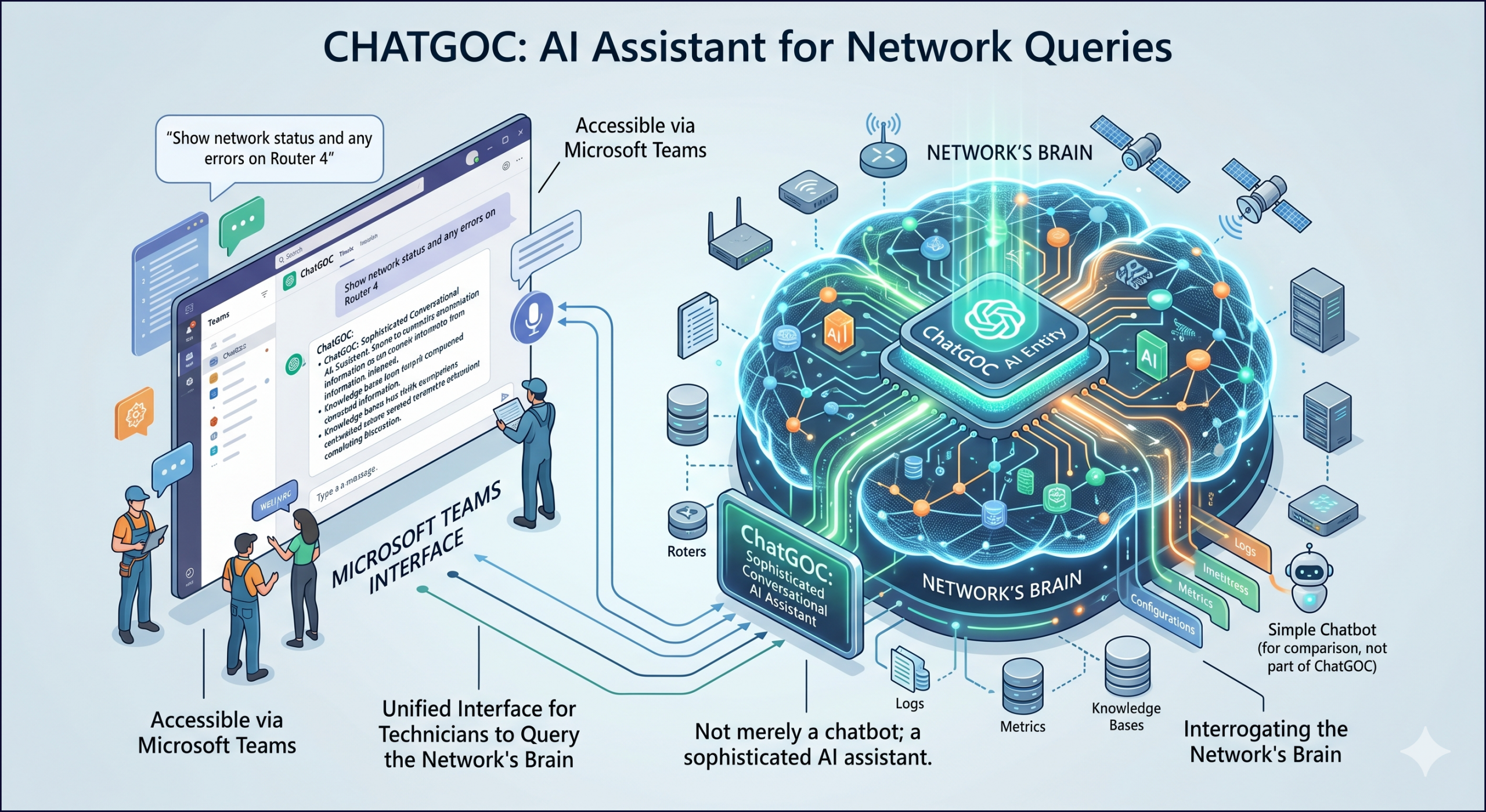
Accessible via Microsoft Teams, ChatGOC provides a unified interface for technicians to query the network’s “brain.” This eliminates the need for human-to-human gatekeeping by putting four critical data streams directly into the technician’s hands:
- Trouble Tickets: Provides instant visibility into ticket ownership and real-time status updates, streamlining team handoffs.
- Alarm Systems: Delivers live telemetry from the network, allowing technicians to see active faults as they trigger.
- Network Inventory: Offers immediate access to equipment configurations on-site, ensuring the right hardware is matched to the right fix.
- Number Portability Processes: Simplifies one of telecom’s most complex workflows by providing instant data on porting status, a key driver in customer retention.
While the tool provides immediate answers, its true value is realized when those answers are needed under the most grueling conditions.
Moving from Monolithic AI to a Scalable “AI Factory”
The strategic failure of many digital transformations is the “zombie bot”—a disconnected, single-use tool that creates massive technical debt. MEO avoided this trap by designing a modular “AI Factory” built on the Microsoft Azure foundation. This approach prioritizes repeatability and scalability, allowing the organization to treat AI development as a streamlined production line rather than a series of isolated experiments.
By shifting from a project-centric to a platform-centric mindset, MEO can rapidly deploy new use cases across various operational domains. This architecture ensures that every new tool benefits from a shared framework, making enterprise growth both sustainable and agile. The “factory” isn’t just a piece of software; it is a blueprint for industrializing intelligence across the entire network.
“We envisioned it as an AI factory, with a flexible platform capable of rapidly developing and deploying use cases across various operational domains.” — Carlos Bouça, Network Engineering and Operations Director at MEO
The “Secret Sauce” is Data Governance, Not Just the Model
There is a common misconception that the power of an AI assistant lies solely in the underlying LLM. MEO’s success reveals a more rigorous truth: the effectiveness of an assistant like ChatGOC is entirely dependent on unified data governance.
Before any information reaches the AI, it is processed through a platform that integrates everything from trouble tickets and alarm systems to mundane but critical number portability processes.
Real-time intelligence is only possible when data is governed and integrated across all internal systems. By aggregating network inventory and equipment status into a single source of truth, MEO ensures that the AI provides actionable insights rather than hallucinations. This focus on data preprocessing ensures that the information reaching the field force is accurate, up-to-date, and strategically relevant.
This shift is a masterclass in removing the friction of information retrieval. By providing instant access to complex data, MEO is augmenting rather than replacing the human element. The technician’s role has been elevated from a data seeker to a solution executor, directly improving both productivity and customer satisfaction.
Toward the Autonomous Network
MEO’s transformation represents a fundamental shift in the telecommunications industry: the move toward a truly autonomous network. By leveraging the AI Factory, the company has redefined operational excellence, reducing costs while simultaneously improving service reliability. The collaboration between MEO and Microsoft Foundry serves as a beacon for how AI can augment human interactions to solve complex, real-world problems.
Ultimately, MEO’s journey suggests that the most successful companies will not be those with the most advanced AI models, but those that can empower their frontline employees with governed, real-time data. As the industry moves forward, one question remains: Is the future of your organization defined by the tools you buy, or by how effectively you can remove the barriers between your data and your people?