Microsoft Foundry – Everything You Need to Build AI Apps & Agents
Foundry serves as an "AI app and agent factory," enabling organizations to accelerate innovation across industries with modular, interoperable, and secure tools.

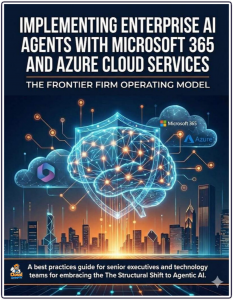 In the dynamic world of artificial intelligence, enterprises require robust platforms to harness AI’s potential for building sophisticated applications and autonomous agents.
Microsoft Foundry, formerly known as Azure AI Studio, stands out as a comprehensive AI platform-as-a-service (PaaS) tailored for this purpose.
Launched as a rebranded and enhanced offering at Microsoft Ignite 2025, Foundry serves as an “AI app and agent factory,” enabling organizations to accelerate innovation across industries with modular, interoperable, and secure tools.
It has empowered thousands of enterprises, including a significant portion of Fortune 500 companies, to develop AI solutions that integrate seamlessly with business contexts and deliver measurable impact.
Foundry distinguishes itself by shifting the paradigm from fragmented AI development to a unified ecosystem. It combines advanced models, prebuilt tools, agentic capabilities, and orchestration features into a single, enterprise-ready platform.
Unlike low-code alternatives such as Microsoft Copilot Studio, which focuses on rapid integrations within Microsoft 365, Foundry adopts a code-first approach, making it ideal for developers crafting custom, complex AI systems. Its consumption-based pricing model ensures cost efficiency, with no upfront infrastructure investments, allowing organizations to scale from prototypes to production effortlessly.
Core Advantages:
- Interoperability: Supports a vast array of models from providers like OpenAI, Anthropic, Meta, and Mistral, with standardized APIs.
- Scalability: Serverless architecture for edge-to-cloud deployments.
- Security and Governance: Built-in compliance, observability, and controls for regulated environments.
- Innovation Focus: Emphasizes agentic AI, where systems evolve from reactive tools to proactive, multi-agent workflows.
What is Microsoft Foundry?
At its essence, Microsoft Foundry is an Azure-based PaaS that unifies AI development, deployment, and management. It functions as a centralized “factory” for creating AI applications and agents, integrating components such as models for reasoning, tools for execution, and orchestration for complex workflows.
This platform addresses the challenges of AI adoption by providing a developer-centric environment that minimizes infrastructure overhead while maximizing productivity.
Foundry’s architecture revolves around a control plane that oversees governance, identity management via Microsoft Entra, and policy enforcement. It supports both cloud-native and on-device deployments through features like Foundry Local, enabling AI to run efficiently on edge devices such as Android and Windows systems.
The platform’s evolution reflects the broader shift toward agentic AI, where applications are not just responsive but capable of autonomous decision-making and collaboration.
Pillars of Microsoft Foundry
Foundry is built on four foundational pillars, each contributing to its comprehensive capabilities:
| Pillar | Description | Key Highlights |
|---|---|---|
| Models | A extensive catalog of over 11,000 pre-optimized models for inference, fine-tuning, and routing. | Includes flagship offerings from Azure OpenAI (e.g., GPT series), Anthropic Claude, Meta Llama, Mistral, Cohere, and more; features like the generally available Model Router for dynamic selection based on cost, performance, and latency. |
| Tools | Managed AI services for adding specialized functionalities without custom development. | Encompasses vision, speech, language processing, and document intelligence; over 1,400 connectors for seamless integrations. |
| Agents | Framework for designing, deploying, and scaling autonomous AI agents. | Supports hosted agents, multi-agent systems, and event-driven triggers; leverages Semantic Kernel or LangGraph for orchestration. |
| Orchestration & Governance | Tools for workflow management, evaluations, and enterprise controls. | Includes agentic RAG for context-aware responses, observability via traces and metrics, and compliance features. |
This modular design allows for flexibility, enabling users to mix and match components to suit specific use cases, from simple chatbots to intricate multi-agent ecosystems.
Key Features and Capabilities
Models and Inference
Foundry’s model ecosystem is one of its strongest assets, offering a diverse selection optimized for enterprise needs. The platform hosts models from leading providers, ensuring users can access the latest advancements without vendor lock-in. The Model Router, now generally available, intelligently directs prompts to the most suitable model, optimizing for factors like accuracy, speed, and cost. Additionally, Foundry supports fine-tuning and edge deployment, with Foundry Local allowing models to run on-device using neural processing units (NPUs) or GPUs.
Tools and Integrations
Formerly known as Azure AI Services, Foundry’s tools provide ready-to-use capabilities that enhance AI applications. These include advanced features for text summarization, translation, sentiment analysis, optical character recognition (OCR), image captioning, and more. The Model Context Protocol (MCP) ensures tools are grounded in real-time data, enabling agents to perform actions like querying databases or sending emails securely.
Agent Service and Multi-Agent Systems
The Foundry Agent Service represents the platform’s commitment to agentic AI. It facilitates the creation of autonomous agents capable of handling complex tasks through reasoning, memory, and collaboration. Multi-agent workflows allow for specialized roles—such as one agent for research and another for analysis—fostering emergent behaviors that mimic human teams. Features like agentic Retrieval-Augmented Generation (RAG) via Foundry IQ integrate external knowledge bases for more accurate, context-aware outputs.
Orchestration, Evaluation, and Observability
Foundry excels in orchestrating AI workflows, with built-in support for evaluations to assess accuracy, safety, and bias. The platform’s observability tools, integrated with Application Insights, provide detailed traces, metrics, and alerts, ensuring transparency in AI operations. This is crucial for debugging and optimizing performance in production environments.
Enterprise-Grade Governance and Security
Security and compliance are paramount in Foundry, with a unified control plane that centralizes management. Features include role-based access control (RBAC), content filters, encryption, and integration with Microsoft Defender for threat protection. The platform holds over 50 certifications, making it suitable for regulated sectors like healthcare and finance. Responsible AI practices, such as red-teaming for bias detection, further enhance trustworthiness.
Ecosystem and Integrations
Foundry integrates deeply with the Microsoft ecosystem, including Azure services, GitHub for collaboration, and tools like VS Code extensions for development. It also supports hybrid setups with Copilot Studio for user interfaces and extends to third-party frameworks like LangChain. For developers, SDKs in Python and C# provide consistent APIs, while the portal at ai.azure.com offers intuitive interfaces for exploration.
Conclusion
Microsoft Foundry redefines AI development by offering an interoperable, secure, and scalable platform that propels organizations into the agentic era. With its focus on modularity and enterprise readiness, it enables businesses to build AI solutions that not only understand but actively contribute to their operations. As AI continues to evolve, Foundry positions itself as a key enabler, supported by ongoing updates like new models and tools announced in June 2025.