End-to-end Capabilities from Microsoft to Build AI Solutions
Build, Deploy, and Govern AI at Enterprise Scale with Azure AI, Fabric, and Copilot

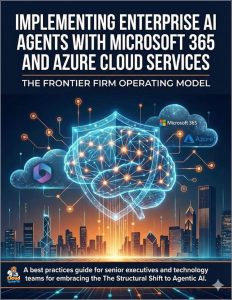 In an era where AI is transforming industries from healthcare to telecommunications, Microsoft stands out with its comprehensive, integrated ecosystem for building, deploying, and managing AI solutions.
Microsoft’s offerings span the entire AI lifecycle—from data ingestion and preparation to model training, deployment, monitoring, and ethical governance.
This end-to-end approach is powered by Azure AI, Microsoft Fabric, Copilot ecosystem, and emerging tools like the Microsoft AI Foundry, enabling organizations to accelerate innovation while maintaining security and scalability.
Unlike fragmented AI stacks that require piecing together third-party tools, Microsoft’s unified platform reduces complexity, lowers costs, and fosters rapid iteration, making it ideal for enterprises aiming for AI-driven transformation.
Data Preparation and Management: The Foundation of AI Success
The journey to effective AI begins with robust data handling. Microsoft’s Microsoft Fabric serves as a unified analytics platform that integrates data engineering, data science, real-time analytics, and business intelligence into a single environment.
Fabric’s lakehouse architecture allows organizations to unify disparate data sources, including structured databases like Azure SQL Database and unstructured data in Azure Cosmos DB, without the need for extensive ETL (extract, transform, load) processes. Built-in AI capabilities, such as Copilot in Fabric, enable natural-language queries to accelerate data preparation, while features like vector search and similarity matching support advanced AI workloads like retrieval-augmented generation (RAG).
For enterprises dealing with massive datasets, Azure’s data services provide scalability. Azure Database for PostgreSQL and Azure SQL Database handle AI-ready applications with high performance, while integrations with tools like Power BI allow for seamless visualization and insight generation.
Fabric’s enhancements include Fabric IQ (in preview), which turns unified data into real-time intelligence for AI agents, emphasizing Microsoft’s focus on data as the bedrock of AI.
Model Development: From Foundation Models to Custom AI
Microsoft empowers developers with Azure AI Studio, a no-code/low-code environment for building custom AI models and applications. Users can access over 11,000 models through Azure AI Foundry, including foundation models from OpenAI (via a partnership extending to 2032), open-source options like Llama from Meta, and Microsoft’s own frontier models such as MAI-1. This multi-model approach avoids vendor lock-in, allowing organizations to mix models for optimal performance—e.g., using GPT for reasoning and Claude for specialized tasks.
GitHub Copilot, the world’s most adopted AI developer tool, integrates seamlessly to boost coding velocity, while Semantic Kernel handles AI orchestration for complex workflows.
For advanced scenarios, ML.NET enables embedded predictions in .NET applications, and tools like Azure OpenAI Service facilitate fine-tuning with enterprise data. Recent 2026 developments include Microsoft’s push toward “AI self-sufficiency” with in-house models trained on gigawatt-scale compute, reducing dependency on partners while maintaining access to cutting-edge tech.
Deployment and Scaling: Bringing AI to Production
Once models are developed, deployment is streamlined through Azure services. Azure Kubernetes Service (AKS) and Azure App Service handle containerized apps at scale, while Azure API Management securely exposes AI endpoints to developers.
For agentic AI—systems that act autonomously—Azure AI Agent Service provides orchestration, tracing, and debugging, enabling multi-agent frameworks like those in telecommunications for natural-language interactions.
Microsoft’s Power Platform, including Power Apps and Power Automate, allows low-code deployment of AI-infused workflows, with Copilot Studio for customizing agents across industries. In 2026, Azure has evolved into an “AI Supercomputer,” supporting inference at global scale with custom silicon and massive CapEx investments exceeding $100 billion annually. This infrastructure ensures seamless scaling, from edge devices like Copilot+ PCs to cloud-based solutions.
Monitoring, Security, and Responsible AI
Post-deployment, Microsoft’s tools ensure reliability and compliance. Azure AI Services include built-in monitoring for performance optimization, safety filters, and content moderation through AI Content Safety. Microsoft Security Copilot, now included in Microsoft 365 E5 subscriptions, integrates AI with Zero Trust for end-to-end protection, detecting threats in real-time.
Responsible AI is embedded via evaluations in Azure AI Studio and initiatives like the AI Access Principles, which prioritize equitable access and ethical deployment. The 2026 Community-First AI Infrastructure initiative addresses infrastructure equity, committing to sustainable data center development in underserved regions. Microsoft’s AI Diffusion Report highlights rapid adoption but warns of divides, driving investments in multilingual models for the Global South.
Integrations and Ecosystem: A Connected AI World
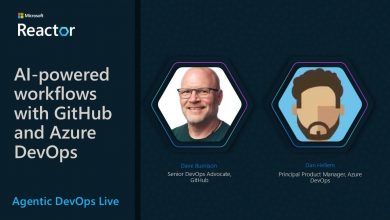
Microsoft’s strength lies in its ecosystem integrations. Copilot—spanning Microsoft 365, GitHub, and Security—infuses AI into daily workflows, with over 150 million monthly active users as of early 2026. Work IQ, a new intelligence layer, powers these tools by leveraging context from Office, Teams, and Outlook. For developers, Agentic DevOps automates end-to-end delivery, from code generation to monitoring.
Industry-specific solutions shine: In telecom, a unified AI platform delivers 2.8x ROI through agentic stores and data unification. Healthcare benefits from MAI-DxO, achieving 85.5% accuracy in complex diagnostics by orchestrating multiple models. Education sees AI skilling for millions via Microsoft Elevate, targeting 20 million people in India by 2030.
2026 Trends and Innovations
Looking at 2026, Microsoft emphasizes agent proliferation, where AI acts as teammates in workflows. Trends include multi-model ecosystems, persistent memory for long-horizon planning, and automation of white-collar tasks within 12-18 months. Sustainability aligns with AI via initiatives like Beyond Davos 2026, balancing transformation with environmental responsibility. Microsoft’s $50 billion investment in the Global South underscores inclusive AI growth.
Conclusion: Why Choose Microsoft’s End-to-End AI?
Microsoft’s capabilities offer a secure, scalable path to AI excellence, with proven ROI—up to 5x in telecom—and tools that evolve with business needs. By controlling the full stack—from cloud infrastructure to developer tools—Microsoft positions itself as the “AI utility” for enterprises.
Whether modernizing legacy systems or pioneering frontier AI, organizations can build solutions that drive measurable outcomes, all while prioritizing responsibility and equity. As AI adoption accelerates faster than any technology in history, Microsoft’s ecosystem ensures you’re not just participating—you’re leading.